Give your WordPress site its first task.
Connect the site you already have, add your agent to Slack or Telegram, and tell it what you need.
Connect your siteStart with 500 free credits. No credit card needed.
A WordPress drop down list is not one feature. The phrase covers navigation submenus, form select fields, WooCommerce variation pickers and catalog sorting, and each of those is owned by a different system. Work out which one you have before you change anything, because applying the right fix in the wrong place is the most common way this turns into an afternoon.
The Services item in your header will not open on a phone. Or a quote form keeps arriving with an empty “Choose a service” value. Or the size picker on a product page renders, but there is nothing inside it. All three get searched as the same thing: a WordPress drop down list.
They are not the same thing. WordPress has no single dropdown feature. The phrase covers at least five surfaces, each owned by a different system, each with its own cause when it stops working. Picking the wrong one and fixing that instead is the expensive mistake here.
| What you see | What owns it | Where you change it |
|---|---|---|
| Submenu under a header link | WordPress menus plus your theme | Appearance then Menus, or the Navigation block |
| Select field in a contact or booking form | Your form plugin | The plugin’s form builder or form-tag |
| Size or colour picker on a product page | WooCommerce variations | Product data then Attributes and Variations |
| “Sort by” box on the shop page | WooCommerce plus the theme template | Theme output of the catalog sorting hook |
| Filter or picker inside wp-admin | Core or a plugin | Code: a metabox, a filter callback, a walker |
Before any of that, answer one question: is the site on a classic theme or a block theme. Classic themes store navigation in the Menus screen. Block themes store it in a template, edited through the Site Editor. If you are unsure which you have, open the Appearance menu and look at what is in it, the same test used for editing a WordPress theme safely: a Customize item points to classic, an Editor item points to block. WordPress.org’s documentation notes that 5.9 was the last version to include the Appearance Menus screen for all sites by default, and that block themes in 6.0 and later manage navigation through the Navigation block.
Editing the wrong screen for your theme type is the top reason people say “I saved it and nothing changed”.
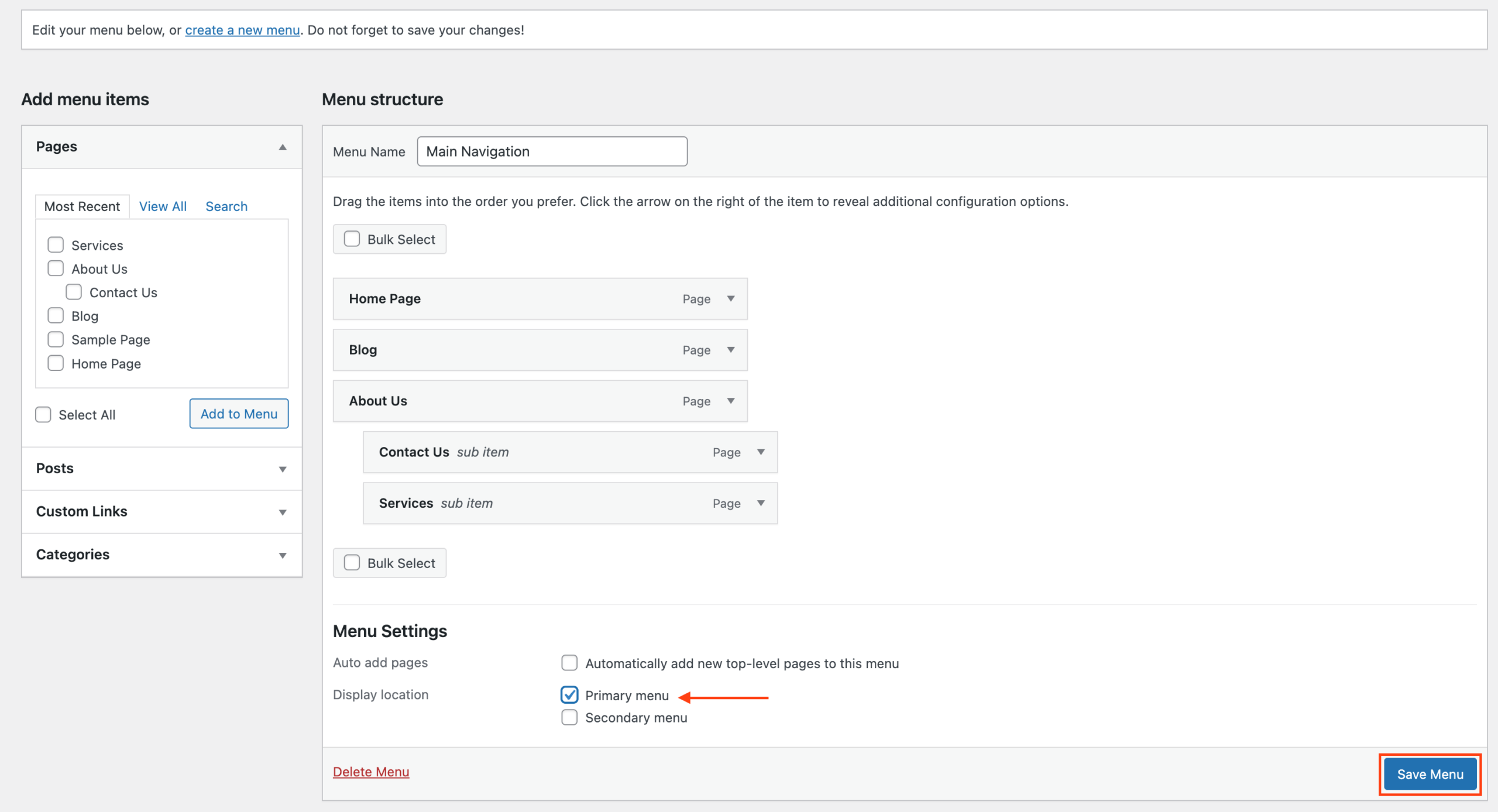
Go to Appearance then Menus. You need an editor or administrator account; no file access is involved.
A correct result looks like this: hovering or tapping the parent reveals the children, and the parent still links to its own page if it has one. If the admin screen shows your items but the front end shows nothing, go back to step 5 first. Missing location assignment is the single most frequent cause, and it takes a minute to rule out.
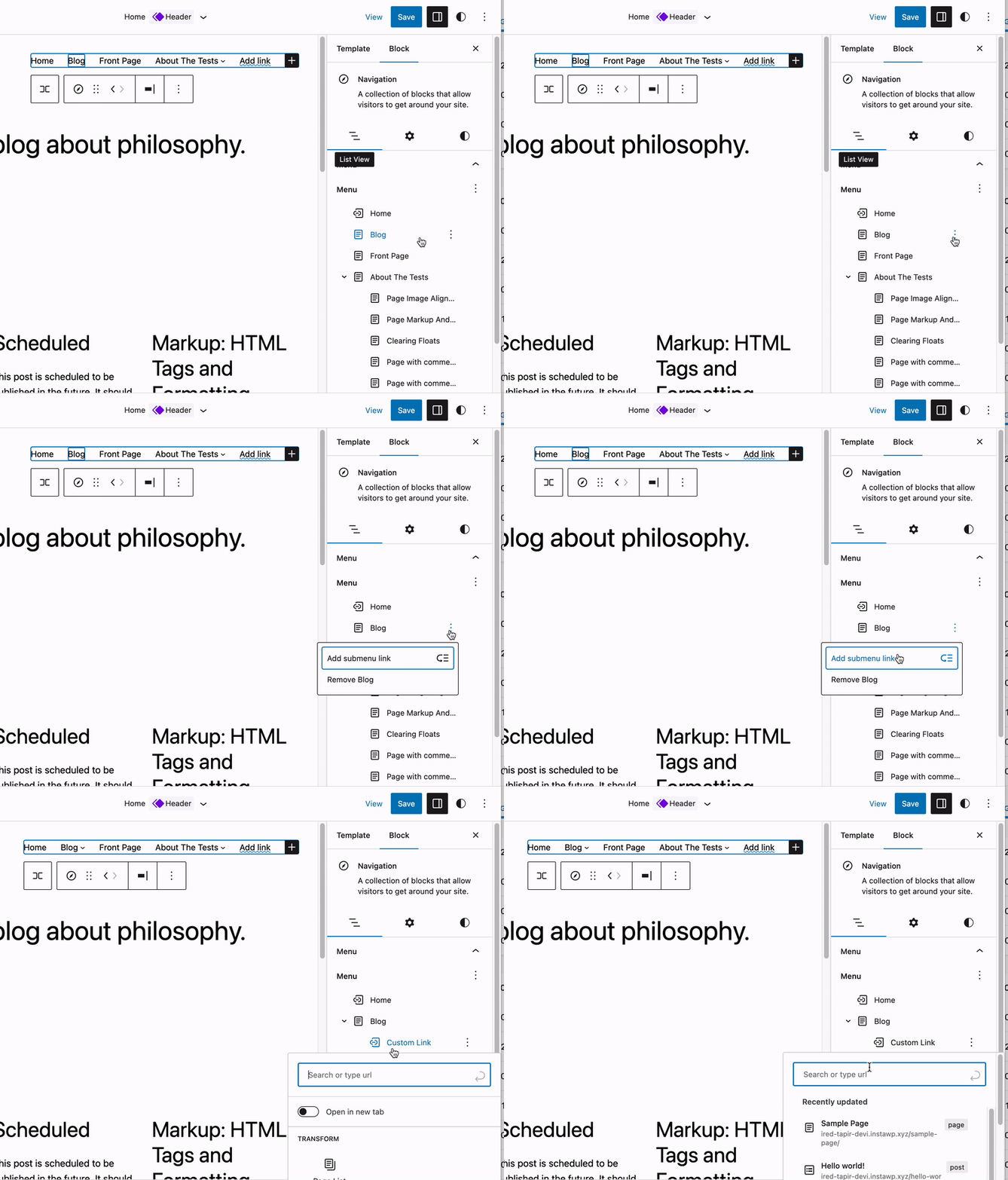
Open Appearance then Editor, then Patterns or Templates, and open the template part that holds your header. Select the Navigation block inside it. The block’s documentation on WordPress.org covers creating a menu, selecting an existing one, and adding submenu items.
The block-theme version of “nothing happened” is usually one of two things: the header template part contains no Navigation block at all, or the block points at a different menu than the one you edited. Both are visible in the Site Editor in about thirty seconds. The same template-part logic applies lower down the page, which is why editing the WordPress footer follows the same route.
Resist the urge to create a second menu when the first one will not appear. Duplicate menus are how a site ends up with different navigation on different templates.
Form dropdowns come from the form plugin, not from WordPress. In a builder like WPForms or Forminator you drag in a Select field, type the options, and set required or multi-select in the field settings. Contact Form 7 does the same job with a form-tag; its documentation covers drop-down menus alongside checkboxes and radio buttons, and the starred version of a tag makes the field required:
[select* service "Web design" "SEO" "Maintenance"]Four decisions matter more than the markup:
Dynamic options, pulled from products, posts or taxonomy terms, are possible but not from core alone. Custom fields with a select, a form plugin’s dynamic choices feature, or a small function that turns terms into options all work. The tradeoff is worth naming: business logic built around a niche plugin is hard to move if that plugin stops being maintained.
Variation pickers and the shop’s sort box fail for different reasons.
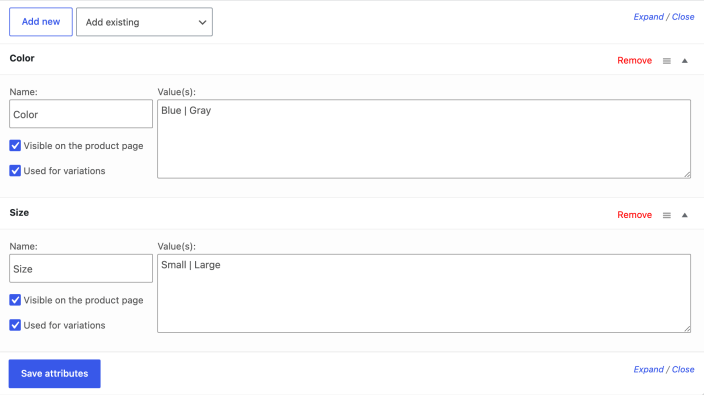
An empty variation dropdown. WooCommerce’s documentation describes variable products as a product type offering a set of variations with their own price, stock and image. The chain has to be complete: set the product type to Variable product, add the attribute with its values, tick Used for variations on that attribute, save, then generate the variations and give each one a price. A select can render and still be empty when the attribute exists but was never marked for variations, or when variations were never created.
A missing “Sort by” box. That control comes from the theme calling WooCommerce’s catalog ordering hook, woocommerce_catalog_orderby. Themes that build their own shop templates sometimes remove it. Restoring it is a template change, which means a child theme and file access, not a settings toggle. Check the theme’s own options first; some expose sorting as a checkbox.
A picker nobody uses. On mobile, a variation dropdown below the Add to cart button gets missed, and you hear about it as “the item is out of stock”. Put selectors above the button, label them explicitly (“Select size”), and show a clear message when nothing is chosen.
Work down this order. It is the sequence that resolves these fastest, because each step is cheaper than the one after it.
z-index too low so the submenu sits behind a sticky header, slider or the admin bar; overflow: hidden or a fixed height on a parent container clipping it; a visibility: hidden or display: none rule that never gets reversed; a gap between the parent and the submenu so the dropdown closes as the pointer travels toward it.Uncaught TypeError or ReferenceError: $ is not defined means the script that opens the menu died. WordPress loads jQuery in no-conflict mode, so custom scripts need wrapping:
jQuery(document).ready(function($) {
  // menu code
});One rule runs through all six: change one thing at a time. Disable five plugins at once and the symptom goes away without telling you what caused it.
If you would rather hand the diagnosis over, SiteSelf takes a report like “the Services submenu does not open on mobile” through chat, does the work on the live site, and reports what it changed and what it checked, which is the kind of request covered by WordPress bug fixes through chat.
Stop before you edit header.php or a wp_nav_menu() call in a parent theme, because the next theme update overwrites it. Stop if the site runs a theme header, a page builder header and a mega menu plugin at once; that is three systems competing for the same navigation, and the fix is choosing one and removing the others, which is a project rather than a tweak. Stop if a copied CSS or JS snippet changes behaviour you do not understand.
A dropdown that only opens on hover is finished for mouse users and broken for everyone else. Keyboard users cannot hover. Touch users cannot either.
For forms, the rule is short: every select gets a visible label associated with it through for and id, with unique IDs on the page. W3C’s WAI tutorial on labeling controls covers that association. Placeholder text inside the select is not a label, no matter how well it reads.
For navigation, W3C’s WAI tutorial on fly-out menus covers making submenus that open on hover also work from the keyboard. Test it yourself in two minutes: put the mouse aside, press Tab through the header, confirm every top-level item shows a visible focus outline, confirm Enter or Space opens the submenu, and confirm focus never vanishes behind a sticky header or an off-canvas panel.
Where you have a choice, use the native <select>. It is announced correctly by screen readers, it behaves the way each phone expects, and it survives plugin updates that break custom widgets. A custom dropdown with search, swatches or grouped options has to earn its place by adding something the native element cannot do, and then it owes you keyboard operation, focus management and correct roles and states.
Same mechanism, different location. On a classic theme, nest the child items and tick the footer or sidebar display location in Menu Settings. On a block theme, open the footer template part and add or edit the Navigation block there. Some themes style submenus only in the header, so a footer dropdown can render as a flat list even when the structure is correct.
Not from WordPress core. The routes people use are a custom fields plugin with a select managed in the admin, a form plugin’s dynamic choices feature, or a small function that converts taxonomy terms or a post type into options. Weigh it against the maintenance you are avoiding: a list that changes weekly is worth automating, a list of five services is not.
Almost always caching or optimisation. Logged-in users typically bypass the page cache, so you see the new markup while visitors get the old one. Purge the plugin cache, the host cache and the CDN, then check whether JS combination or defer is reordering the menu script.
Only when the requirement genuinely exceeds core: multi-column layouts with images, or marketing staff who need to edit promotional panels themselves. Plain parent and child items in the built-in menu system cover most sites, and they break far less often after an update. If you do add one, remove whatever else was controlling the header.
That is a different UI pattern, built with JavaScript rather than a plain select, and usually supplied by a plugin or a library. It carries the full accessibility cost of a custom widget. If a list is long enough to need search, consider whether two dependent dropdowns or a different field type would serve people better.
Two likely causes. Template edits made directly in the parent theme were overwritten, which is why menu code belongs in a child theme. Or the update changed menu locations and your menu lost its assignment. Check Appearance then Menus, or the Navigation block in the header template, before touching anything else.
How-to Tutorials
Enabling WordPress Multisite takes five steps and about ten minutes. What takes the afternoon is the part nobody writes down: DNS, web server config, wp-config constants and rewrite rules all have to agree, and when they do not, the symptoms point somewhere other than the cause. This is the install sequence, the decisions that come before it, and the order to check things in when a subsite returns a 404.
Read article ›How-to Tutorials
Changing the footer in WordPress is rarely hard. Finding which layer controls it is, because block themes, classic themes, page builders and theme files can each own the same strip of text. Work out which one is rendering your footer first, then edit only in that place.
Read article ›How-to Tutorials
There is no single way to edit a WordPress theme. There are three layers, and picking the wrong one is why edits vanish after an update or take the site down. This is how to tell which layer a change belongs in, and how to make it there.
Read article ›Connect the site you already have, add your agent to Slack or Telegram, and tell it what you need.
Connect your siteStart with 500 free credits. No credit card needed.