Give your WordPress site its first task.
Connect the site you already have, add your agent to Slack or Telegram, and tell it what you need.
Connect your siteStart with 500 free credits. No credit card needed.
“wp list plugin” is one phrase covering four unrelated jobs: taking an inventory of installed plugins, putting a list of posts on a page, building a data table, and recovering a Plugins screen that will not open. The right answer depends entirely on which of those you mean. Name the object you are listing first, and most of the wrong choices disappear.
“wp list plugin” is not the name of a plugin. It is what people type when they want one of four different things, and those four have almost nothing to do with each other.
Search results mix all four, which is why the first search rarely helps. The fix is to name the object you are listing and who reads the list. A heading list for readers, a post query for a resources page, and a CSV of active plugins for your own records need three different tools. This article separates them, gives the command or the setting for each, and covers the failure modes that follow. If the reason you are looking is that something already broke, start with the guide to plugins that are not working and come back here for the inventory part.
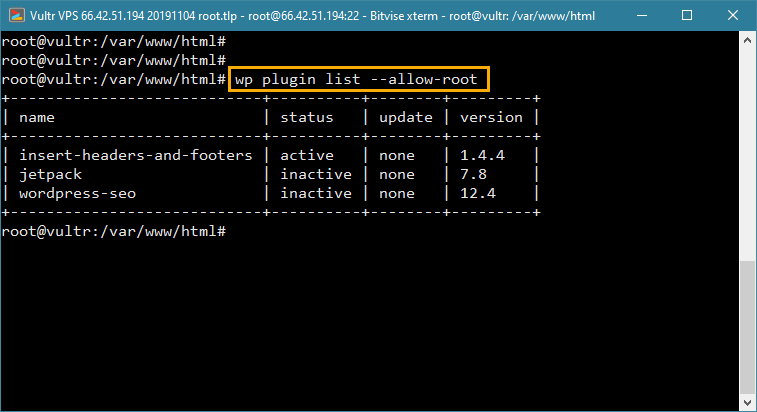
WP-CLI puts the noun before the verb, so the real command is wp plugin list. There is no wp list plugin alias. WordPress’s developer documentation describes the command as displaying the plugins installed on the site with activation status and whether an update is available.
wp plugin list
wp plugin list --status=active
wp plugin list --update=available
wp plugin list --fields=name,version,update
wp plugin list --format=csv > plugins-inventory.csv
Those last two are the ones that earn their keep. --update=available answers “what needs updating right now” in one line, across one site or fifty. The CSV export answers “what was active before I started touching things”, which is the record you want when a conflict hunt goes sideways and you need to put the site back the way it was.
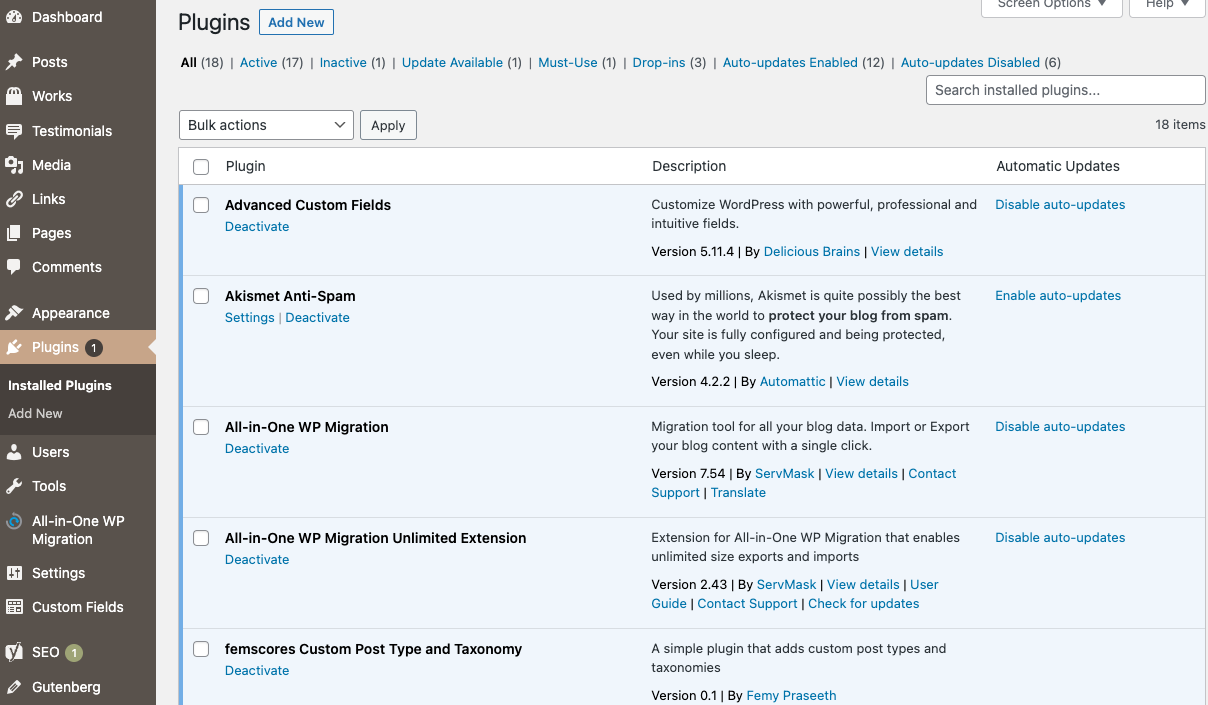
No shell access? The same inventory is on the admin Plugins screen at wp-admin/plugins.php, filtered by Active, Inactive and Update Available. It is slower to read and harder to keep a copy of, but it is the same data. Must-use plugins are the exception: they live in wp-content/mu-plugins, load unconditionally, and cannot be deactivated from that screen, so an audit that ignores them is incomplete.
Ranked by how often it actually happens:
--path. WP-CLI needs to run inside the WordPress install or be told where it is: cd /var/www/mysite, or wp plugin list --path=/var/www/html/wordpress. Pointing --path at the document root when WordPress lives in a subdirectory means wp-config.php is never found. The worse version of this mistake is pointing it at a staging install: you get a clean, plausible list that describes the wrong site.wp-config.php the site does, so bad credentials or a down database server break every command that boots WordPress. Repair the credentials rather than experimenting in that file: a stray character in wp-config.php takes the site down along with the CLI.wp-content/plugins. Wrong ownership produces read errors or a short list. Fix the ownership. Do not chmod 777 the plugin directories to make the error go away, because that trades a listing problem for a security problem and many hosts will flag it.This is the job most people mean when they want a plugin. The selection error that costs the most time is choosing by layout (“I want cards”) instead of by object (“I am listing posts from one category”). Plugins are not interchangeable across object types.
| What you are listing | Start with |
|---|---|
| Posts, pages or a custom post type, on a block theme | The core Query Loop block, which WordPress’s documentation describes as displaying posts based on specified parameters |
| Categories or terms as a simple index | Core’s wp_list_categories(), which displays or returns the HTML list of categories |
| Posts from one or more categories, inside classic content | List Category Posts, which lists posts by category using the [catlist] shortcode |
| Hand-maintained tabular data such as a price list or spec sheet | TablePress, which creates and manages data tables without writing code |
| A clickable list of the headings inside one article | Easy Table of Contents, which inserts a table of contents generated from the page content into posts, pages and custom post types |
Try core before you install anything. A Query Loop block and a category list cover a surprising share of “I need a list plugin” requests, and they carry no update burden of their own. Reach for a plugin when the list needs something core does not do: grouping posts under year or author headings, a searchable catalog table, filtering by custom fields.
Check the plugin page before you install, not after. WordPress.org shows a compatibility warning on plugins that have not been tested with the latest three major releases, and the Display Posts plugin page carried that warning when we checked it in September 2023. That notice is not a verdict, but on a plugin whose whole purpose is rendering a list on a public page, it is a reason to look at the support forum before committing a client site to it.
Almost every “this plugin is broken” report for a list plugin turns out to be one of five configuration problems. Work down the list before you open a support ticket or swap plugins.
wp-content/plugins/<slug>/. Uploads that land in mu-plugins or one level too high look installed and behave like nothing.akismet.You need the Plugins screen precisely when you are doing updates, and that is when it tends to break. The symptom is “There has been a critical error on this website” on wp-admin/plugins.php only, often immediately after a core update.
Triage before you touch the database. Write down the exact error text, the screen it appears on, and the last change made. Then read wp-content/debug.log or the host error log and look at the file path in the fatal: a path under wp-content/plugins/ makes a plugin the first suspect, a path under wp-content/themes/ points at the theme or child theme, and “Allowed memory size” is a resource limit rather than a broken screen. If wp-admin is unreachable entirely, renaming a plugin folder over SFTP forces that plugin to deactivate, and renaming the active theme folder forces a fallback to a default theme.
One cause is specific to this screen and worth knowing. WordPress keeps a recently_activated row in wp_options, and if that value ends up as something other than a valid array, rendering the Plugins list throws a fatal error. The fix is to open the database in phpMyAdmin or Adminer, find the recently_activated row in the options table, and delete it. WordPress recreates it and the screen loads again.
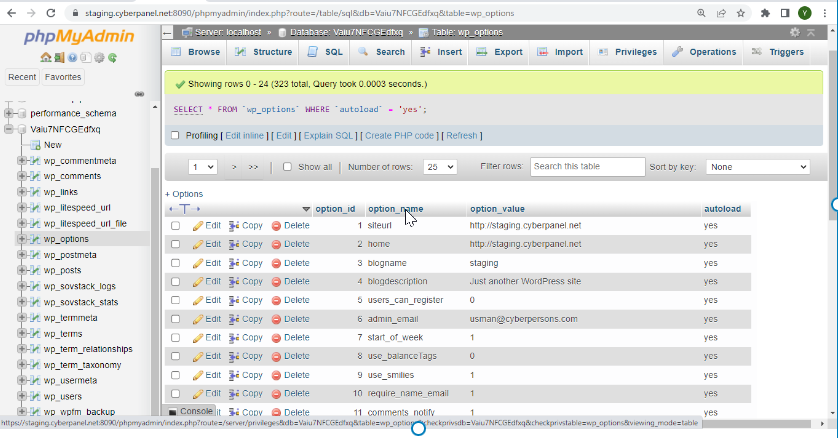
Three ways people make this worse. They delete the wrong row, and removing active_plugins deactivates every plugin on the site. They search wp_options on a site with a custom prefix such as wp123_options, find nothing, and conclude the diagnosis was wrong. Or they try to repair the serialized value by hand and leave it malformed in a new way. Delete the row, do not edit it.
If wp-admin is completely inaccessible, the same normalization can be done from a must-use plugin at wp-content/mu-plugins/fix-recent.php that filters option_recently_activated and returns an empty array when the stored value is not an array. Files in mu-plugins load early and unconditionally, which is the point. Get the <?php tag and the braces right, because a syntax error there fires before your filter can help. A PHP version downgrade in the hosting panel sometimes restores access, but treat it as a way to buy an hour, not a fix: the bad data is still there, and other plugins may not run on the older version. If none of that is a comfortable afternoon, this is the point to have the error diagnosed for you rather than experimenting on a live site.
The listing question is small. The process around it usually is not: someone decides what the list should show, someone else knows which plugin the site already has, and the change waits for whoever has database or SFTP access. That is the part worth removing.
Example request: “Our /resources page should list every post in the Guides category, newest first, with excerpts and a thumbnail. Use core blocks if the theme supports it. Only add a plugin if there is no other way, and tell me which one and why.”
SiteSelf reads the theme and the page first, builds the list with a Query Loop block where the theme is a block theme, and falls back to a shortcode from a plugin the site already runs before proposing a new one. Before making the change it says what is about to change and whether it can be undone. Afterwards it fetches the page and reports in plain language what it sees: how many posts rendered, whether the excerpts are there, whether the query returned nothing. Content and settings work needs the SiteSelf Connector plugin from the WordPress.org directory; editing a template file or functions.php needs hosting access over SSH.
The limits are worth stating plainly. If /resources is owned by Elementor, Divi or Beaver Builder, the agent refuses at the moment of work and tells you why. Verification is a fetch of the changed page and a report, not a screenshot and not a device test, so a list that renders correctly can still need your eyes on a phone. Work happens on request, so nothing is being watched between requests. The same request shape covers the inventory side of this topic, which is where plugin maintenance handled in chat fits: ask what is installed, what is inactive, what has an update waiting, and what can be removed.
No plugin by that exact name shows up in the WordPress.org directory as a widely used tool. The closest literal matches are unrelated: “WP-list” is a marketplace cross-listing connector for eBay, and the rest of the results are plugins with “list” in the name that do very different jobs. Most people searching the phrase want the wp plugin list command or a content list on a page.
Run wp plugin list --format=csv > plugins-inventory.csv from the WordPress install directory. Add --fields=name,version,update to narrow the columns, or --field=name for names only. Always export CSV rather than parsing the default table output, which is formatted for reading and not for scripts.
WP-CLI’s documentation for wp post list notes that it shows only the ‘post’ post type by default. Pass --post_type=page for pages, or your own post type slug for a custom post type. Add --post_status=draft or --post_status=trash when the posts you expect are not published.
Not if you are comfortable with a small amount of PHP. wp_list_categories() is core, it displays or returns the HTML list of categories, and its hide_empty argument drops categories with no posts. Wrapping it in a shortcode registered in your child theme’s functions.php means editors can place it without touching templates. A mistake in that file breaks the theme, so make the edit over SFTP where you can undo it, or use a plugin instead.
Check the “Tested up to” value on the plugin’s directory page before a major core upgrade, and give extra attention to any plugin that adds custom columns, bulk actions or filters to admin list screens, because those hook into core internals that change more often than the public APIs. Test on staging first. Removing plugins you no longer use is the cheapest way to shrink the surface that can break.
The list of what was active, saved somewhere outside the site: wp plugin list --status=active --format=csv, or a screenshot of the Plugins screen filtered to Active. Conflict hunting means deactivating everything and reactivating one at a time, and without that record you will not know which plugins were meant to be off.
How-to Tutorials
Changing the footer in WordPress is rarely hard. Finding which layer controls it is, because block themes, classic themes, page builders and theme files can each own the same strip of text. Work out which one is rendering your footer first, then edit only in that place.
Read article ›Troubleshooting
A plugin that stopped working almost never stopped on its own. Something changed first: an update, a PHP version, a cache rule, a snippet pasted into a theme file. The fastest route back is to find what changed, test one variable at a time, and resist the urge to fix three things at once.
Read article ›How-to Tutorials
There is no single way to edit a WordPress theme. There are three layers, and picking the wrong one is why edits vanish after an update or take the site down. This is how to tell which layer a change belongs in, and how to make it there.
Read article ›Connect the site you already have, add your agent to Slack or Telegram, and tell it what you need.
Connect your siteStart with 500 free credits. No credit card needed.